You spot a $180 charge for a package that never arrived. The merchant says to wait. Your credit-card bill is due next week. Should you pay, call the bank, or ask for a chargeback?
The short answer: Contact the seller when appropriate, notify your credit-card issuer promptly, and protect your federal billing-error rights by sending a written notice to the issuer's billing-inquiries address within 60 days after the first statement showing the error was sent. Keep paying the part of your bill that is not disputed. The exact process can differ for defective goods, debit cards and disputes that do not qualify as billing errors.
First, identify what went wrong
Not every disappointing purchase is the same kind of dispute. The federal Fair Credit Billing Act (FCBA) and its implementing rules cover qualifying billing errors on open-end credit accounts. Common examples include:
- A charge you did not authorize.
- The same purchase billed twice, an incorrect amount, or an arithmetic mistake.
- A payment or credit that the issuer failed to post properly.
- Goods or services charged but not delivered as agreed or not accepted.
- A charge for which you need clarification or documentary evidence.
For a defective item you received and accepted, different claims-and-defenses rules may apply, including conditions and exceptions. Do not assume that every return disagreement automatically qualifies for the billing-error procedure. The CFPB's refund guidance explains the distinction.
The 60-day clock: what actually starts it?
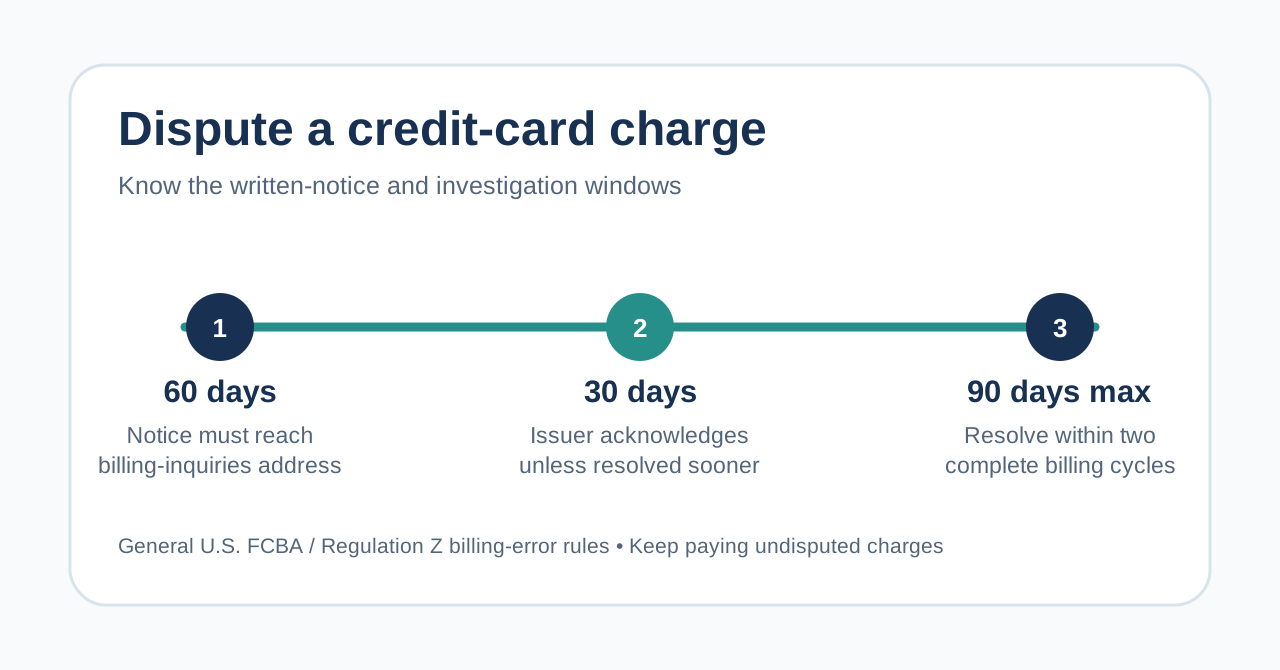
For a qualifying billing error, the federal written-notice deadline is generally 60 calendar days after the creditor transmitted the first periodic statement reflecting the error. It is not necessarily 60 days from the purchase date, the date you opened the package, or the day you noticed the problem.
Suppose your card issuer sends a statement on November 10 showing a $180 incorrect charge. The 60-day notice period generally runs from that statement's transmission, not from the day you placed the order. Do not wait until the last day: under Regulation Z, section 1026.13, the issuer generally must receive the qualifying notice at its designated address within that window.
An issuer may voluntarily investigate a later dispute, but missing the statutory deadline can cost you specific legal protections. Act promptly even when the merchant promises to fix things.
Five steps to dispute a credit-card charge
1. Check the transaction and collect evidence
Look for a merchant name you recognize under a different billing descriptor. Compare the amount, order confirmation, return receipt, tracking details, messages and statement date. Keep screenshots or copies of documents, but do not send your complete card number in ordinary email.
2. Contact the seller when it makes sense
For missing merchandise, an incorrect amount or a refund, ask the seller for a correction and document the response. A seller may resolve the issue faster than a formal investigation. But do not let merchant conversations run out your issuer's 60-day written-notice window. For a suspected fraudulent charge, contact the issuer immediately instead of trying to negotiate with an unfamiliar merchant.
3. Tell the card issuer right away
Call the number on the back of your card or use its dispute channel. Explain the amount, transaction date and reason. Ask whether the card should be locked or replaced if fraud is suspected. Record the date, case number and what the issuer said.
4. Send a written billing-error notice
To preserve federal FCBA rights, follow up in writing at the billing-inquiries address shown on your statement, which may differ from the payment address. Include your name, identifying account information, disputed amount, transaction date, and a clear explanation of the error. Attach copies of relevant proof, not originals. Keep a copy and evidence of timely delivery.
The FTC provides a sample dispute letter. The CFPB also recommends a written notice even if you first called or disputed online. Follow your issuer's official billing-rights instructions for permitted delivery methods; a phone call alone does not preserve these statutory rights.
5. Pay the undisputed portion and follow up
While a qualifying billing-error investigation is pending, you generally do not have to pay the amount in question or related finance charges. You do need to make timely payments on the rest of your account. Avoid treating the entire statement as optional.
For example, if your $1,000 statement includes a disputed $180 charge, the remaining $820 is not automatically excused. Your exact required payment depends on your account and applicable terms; ask the issuer to clarify how to pay the undisputed portion while preserving your rights.
What happens after you send the letter?
Under Regulation Z's billing-error rules, the issuer generally must acknowledge a timely written notice within 30 days, unless it resolves the dispute sooner. It must complete the required resolution process within two complete billing cycles, and never later than 90 days after receiving the notice.
The issuer can correct the error or explain in writing why it believes some or all of the amount is owed. A temporary credit is not necessarily a final decision. If the issuer finds the bill correct, read its written explanation and the due-date information carefully; follow any further dispute or complaint steps promptly.
During a qualifying investigation, the issuer generally cannot try to collect the disputed amount, impose finance charges on that amount, or report you delinquent for withholding only that disputed amount. This does not excuse unrelated late payments.
What about an unauthorized or stolen-card charge?
Report suspected fraud immediately. Federal law generally caps liability for unauthorized credit-card charges at $50, and many issuers offer stronger zero-liability protections under their own terms. If a physical card is lost, report it immediately to stop additional misuse. The FTC's lost-or-stolen-card guide explains the key differences.
Do not confuse these protections with debit-card rules. Debit cards use a different legal framework and notification deadlines; the amount you could lose can depend on how quickly you report a problem. This article focuses on U.S. consumer credit cards.
What if the item was defective, not missing?
Start by requesting a repair, replacement or refund from the seller and preserving the correspondence. A defective-goods dispute may involve a separate right to assert certain claims or defenses against the card issuer, subject to legal conditions. Ask the issuer what process applies rather than labeling every product-quality complaint an unauthorized charge. See the CFPB's guidance on refunds and chargebacks.
A simple dispute checklist
- Save the first statement containing the problem and note when it was sent.
- Gather the order, receipt, delivery record, refund promise and merchant messages.
- Contact the issuer promptly and send a timely written billing-error notice to its designated address.
- Pay the undisputed balance on time and retain payment confirmations.
- Calendar the acknowledgment and resolution windows; review the final written decision.
A dispute is easier when you already have good records. Our guide to statement balances and payment dates can help you avoid accidentally missing an unrelated payment. For the broader picture, read how credit scores work.
Frequently asked questions
Can I dispute a charge after I paid it?
Yes, you can still raise a dispute, although the timing and refund process can differ. A paid charge does not erase the importance of the federal written-notice deadline. See the CFPB's dispute FAQ.
Is filing a dispute online enough?
An issuer may accept online disputes, but the CFPB and FTC recommend following up with the written notice required to protect your federal billing-error rights. Use the billing-inquiries instructions on your statement and preserve proof of receipt.
Does a chargeback guarantee my money back?
No. A chargeback or provisional credit may be reversed if the issuer concludes the transaction was valid. Present accurate evidence and read the final decision.
Can I stop paying my entire credit-card bill?
No. The special right to withhold payment during a qualifying billing-error investigation applies to the disputed amount and related charges, not unrelated purchases or balances.
The habit that protects you before a dispute
Check every statement, keep receipts for major purchases, turn on transaction alerts when available, and save important merchant communications. A few minutes of monthly review can make a real difference when something goes wrong.
Sources and scope: This U.S. consumer-education article was researched November 3, 2026 using the CFPB billing-error guide, Regulation Z section 1026.13, the FTC dispute overview, and the FTC sample letter. It is general education, not legal advice; check your issuer's current billing-rights notice and seek qualified help for a complex dispute.