A credit score can influence the interest rate on a mortgage, a car loan, or a credit card. But a score is not a grade for how wealthy you are, and improving it does not require paying interest. The foundation is simpler: make payments on time, use credit responsibly, and give your record time to grow.
The short version: Pay every account on time; keep credit card balances small relative to your limits; check your credit reports for mistakes; avoid unnecessary applications; and pay credit card statement balances in full whenever you can. There is no guaranteed shortcut to an 800 score.
What is a credit score?
A credit report is a record of your credit accounts: when they opened, balances, reported payment histories, credit inquiries, and certain negative events. Lenders and other businesses provide information to credit reporting companies, primarily Equifax, Experian, and TransUnion. Not every lender reports to every bureau, so the three reports may differ.
A credit score is a prediction produced by a mathematical model using information in a credit report. It helps a lender estimate the risk that a borrower will fall behind. A score is not the same thing as a credit report, and the report itself generally does not contain a score.
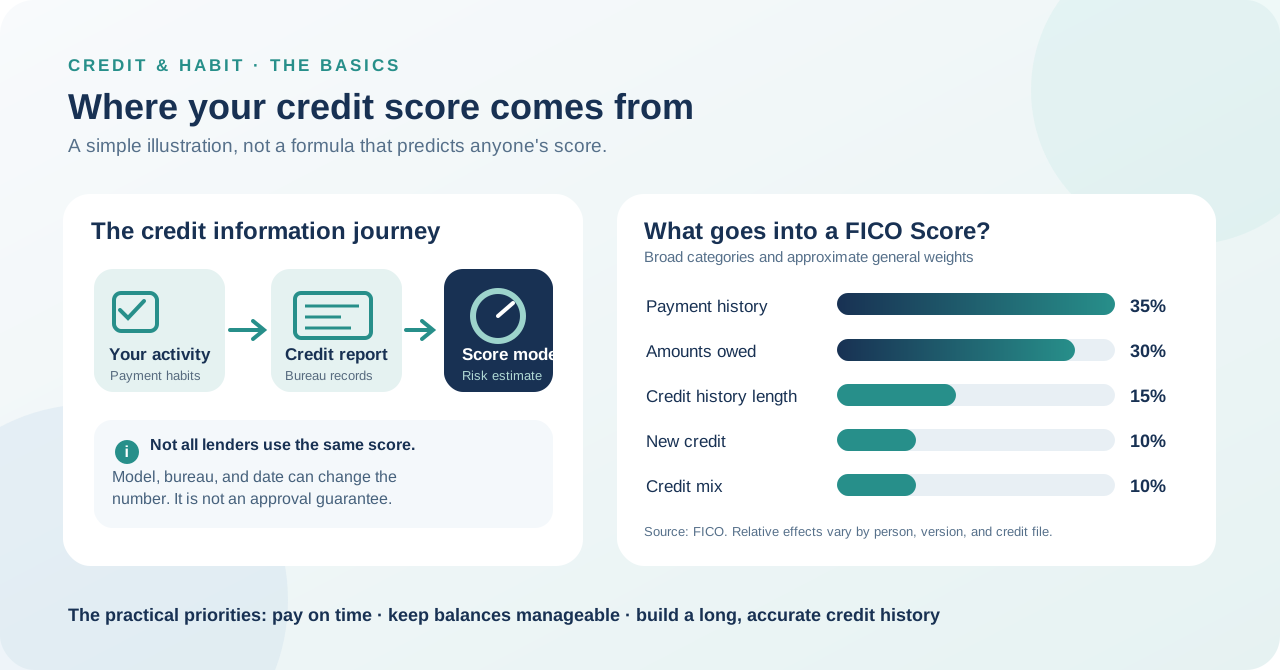
Think of it as a process: You use credit → lenders report account information → credit bureaus create reports → scoring models calculate scores → lenders consider scores alongside income, debt, and other underwriting criteria. The Consumer Financial Protection Bureau (CFPB) explains both the credit report and the credit score.
Why do I have more than one score?
There is no one official score that every lender sees. FICO and VantageScore are different model families; each has multiple versions. Scores also vary with the credit bureau's data, when the score was calculated, and the kind of credit being considered. A mortgage lender might use a different score from the one your bank displays in its app.
That is why two legitimate credit-score services may display different numbers on the same day. Instead of chasing an exact match, track the model, version, bureau, and date shown beside each score. A lender also considers factors beyond scores, so even an excellent score does not guarantee approval. See the CFPB's explanation of why scores differ.
What counts as a good credit score?
Many commonly used FICO Scores run from 300 to 850. In FICO's general rating scale, below 580 is poor, 580–669 is fair, 670–739 is good, 740–799 is very good, and 800–850 is exceptional. These are FICO's descriptive bands, not lender approval thresholds. Other models may have different ranges or labels. A 760 may already be competitive for many offers; a higher number never replaces checking a lender's actual eligibility rules.
Source: FICO's published score ranges.
The five factors behind a FICO Score
FICO publishes five broad categories for its general scoring framework. The percentages describe the approximate relative importance of categories across the population, not a precise formula you can use to calculate your own score. Different FICO versions, VantageScore models, and individual credit files can behave differently.
- 35% — Payment history. Did you pay accounts as agreed? Missed payments, collections, and more serious delinquencies can be damaging. Recent, repeated, or severe delinquencies generally matter more.
- 30% — Amounts owed. Includes debt balances and, importantly for credit cards, how much of each credit limit and your combined limits you're using.
- 15% — Length of credit history. Age of your oldest and newer accounts, average age, and how long accounts have been used.
- 10% — New credit. Recent credit applications and newly opened accounts.
- 10% — Credit mix. Experience with different types of credit, such as revolving credit cards and installment loans. Do not borrow money just to improve your mix.
Important: Payment history and amounts owed together account for 65% of the broad FICO framework. They are the most useful everyday priorities. Source: FICO's own factor breakdown.
Credit utilization: the percentage that can change quickly
Utilization = reported credit card balance ÷ credit limit × 100.
Imagine one card with a $5,000 limit. If it reports $1,000, utilization is 20%. If it reports $4,000, utilization is 80%. Even if you always pay on time, the higher reported balance can temporarily weigh on your score. Scoring may consider both your total utilization and individual cards that are close to their limits.
You will often hear the 30% rule. It is a useful caution against high balances, not a magical boundary where 29% is good and 31% is bad. The CFPB notes that some experts recommend 30% or less and others suggest below 10%. Lower reported utilization may help, but no specific percentage guarantees a score, and you do not need to carry debt to establish credit. CFPB: rebuilding your credit.
Why a paid-in-full card can still show utilization
The amount shown on your credit report is not always your balance after you make the monthly payment. Creditors report on their own schedules, often around a statement date, and a score uses the data available when calculated. Say you spend $1,200 on a $2,000-limit card, receive a statement, and pay the full $1,200 by the due date. You may pay no purchase interest while still seeing 60% utilization in a snapshot taken before that payment.
If you are preparing for a credit application, ask your issuer when it reports and consider paying down a large balance before the reporting or statement date. But do not miss the actual due date: that is the payment deadline. Your statement date and payment due date serve different purposes. The CFPB explains why scores can reflect a high balance even after you pay it.
The difference between minimum payment, statement balance, and current balance
- Minimum payment: The smallest required payment to keep your account current. Paying only this can leave expensive interest accruing.
- Statement balance: What you owed when the billing cycle closed. With a purchase grace period, paying this in full by the due date generally avoids interest on new purchases.
- Current balance: The running total, which may include charges made after the statement closed. It can be higher or lower than the statement balance.
Best everyday habit: Set autopay for at least the minimum as a backup, and, if your cash flow allows, set it to pay the full statement balance by the due date. Confirm your bank account has sufficient funds. You do not need to pay interest to build credit or earn rewards; carrying a balance can make rewards far less valuable.
Grace periods are not universal, and cash advances often begin accruing interest immediately. If you have been carrying a balance, check your issuer's terms before assuming the grace period has returned. See the CFPB guide to credit card grace periods.
How to build credit from scratch: a realistic first-year plan
Step 1 — Check whether you already have a credit file. Request reports from Equifax, Experian, and TransUnion at AnnualCreditReport.com, the official federally authorized site. At present, free online reports from each nationwide bureau are available weekly. Reviewing your own credit reports does not lower your score. These reports are not the same as a free credit score.
Step 2 — Choose one sensible starting account. If you cannot qualify for an ordinary credit card, consider a secured credit card from a reputable bank or credit union. You make a refundable security deposit subject to the agreement and obtain a credit line. Before applying, verify the issuer reports positive payments to all three major bureaus, review annual fees and APR, and understand when or whether the deposit can be returned. A credit-builder loan can be another route, but compare costs and do not borrow without a clear benefit. The CFPB lists ways to start or rebuild credit.
Step 3 — Use the account lightly and pay predictably. Put a manageable purchase on the card, check statements, and pay on time. Never make a purchase purely to raise your score. If you keep a card active, one modest recurring purchase can be easier to manage than constant spending.
Step 4 — Allow time for your history to develop. In general, a classic FICO Score requires an account at least six months old and at least one account reported in the past six months, among other requirements. That is not a promise you'll reach a particular score in six months, and other scoring models can have different requirements. FICO explains its minimum scoring requirements.
Step 5 — Review the account and upgrade options. After a period of responsible use, ask whether your secured card can graduate to an unsecured card with your original deposit returned, and whether you can avoid an additional hard inquiry. No issuer is required to approve an upgrade.
Can an authorized-user account help?
Sometimes. An authorized user may benefit from an established account's positive history if the issuer reports that account to the bureaus and the scoring model counts it. But late payments or high balances on that account can also create problems, and an authorized user is not the same as being the person legally obligated to repay. Don't buy access to a stranger's account or treat authorized-user status as a guaranteed shortcut.
Does paying rent, utilities, or a debit card build credit?
Not automatically. Most utility companies do not report ordinary on-time payments to the three major bureaus, though collections might appear. Some rental payment programs can report positive rent, but fees and scoring-model treatment vary. Ask which bureaus receive data, what kinds of payment history they report, and what the service costs. An ordinary debit-card purchase does not normally create a credit-card repayment history. See the CFPB on utility reporting and rent reporting.
If your score is low: where to start improving it
First, get current on past-due accounts. Set reminders or autopay for amounts you can afford; if you're already behind, contact the lender promptly about hardship options. Second, reduce credit card balances, especially cards near their limits. Third, pause unnecessary credit applications while establishing a consistent payment record. Fourth, look for inaccurate entries on every bureau report.
If you find an error, dispute it with both the credit bureau and the company that furnished the information, and include supporting evidence. The CFPB has a step-by-step dispute guide and sample letters. Accurate negative information generally cannot be erased simply because you paid someone to remove it; most negative credit-account information can remain for up to seven years, with special rules for some events. Beware firms that promise a rapid fix or a new credit identity. See the FTC's credit-repair scam warning and the CFPB's reporting-time explanation.
How long will an improvement take? Utilization changes can affect a score when new balances are reported and the score is recalculated, whereas rebuilding payment history can take many months or longer. No legitimate service can promise a particular score gain on a fixed schedule.
Do hard inquiries hurt your score?
Checking your own report is a soft inquiry and does not hurt your score. Applications for credit may create hard inquiries, which can have a modest negative effect, especially if you open several accounts in a short period. Prequalification may use a soft inquiry, but confirm this before submitting personal information.
For many scoring models, multiple inquiries for one kind of mortgage, auto, or student loan within a 14-to-45-day shopping period can be treated as one inquiry. That exception does not mean you can apply for unlimited credit cards without consequence. Sources: CFPB on soft and hard inquiries and rate-shopping windows.
Five popular credit-score myths, corrected
- “I need to carry a balance to prove I can use credit.” False. Pay in full when possible; interest is not a score-building requirement.
- “Every score I see should be identical.” False. Bureau data, model, version, and date can all differ.
- “30% utilization is a required target.” False. It is a guideline, not an ideal goal or fixed scoring cutoff.
- “Closing a card always helps because it removes the debt.” Not necessarily. Closing can reduce available credit and raise your utilization; consider fees and your ability to manage the account.
- “A higher income automatically raises my FICO Score.” Income is not one of the five credit-report-based FICO scoring categories. Lenders can still review income in deciding whether to extend credit.
Sources: CFPB credit-score guidance, CFPB on account closure, and FICO's score methodology.
How to monitor your credit and protect your identity
Review all three credit reports periodically at AnnualCreditReport.com. Compare account ownership, balances, payment status, and recent inquiries; report mistakes quickly. Many banks and credit card companies provide a free score, but check which model it uses. A score is a helpful signal, not a substitute for inspecting your report.
Consider a free security freeze at Equifax, Experian, and TransUnion, especially if you are not planning an application. A freeze does not hurt your score and can make it harder for an identity thief to open a new credit account. Remember to lift it temporarily when a legitimate lender needs access. If you spot identity theft, use IdentityTheft.gov for official recovery guidance. Source: FTC on credit freezes.
More questions people ask about credit scores
What happens if I pay a credit card bill a few days late?
Missing the due date may trigger a late fee or interest consequences even if no late payment appears on your credit report yet. Creditors commonly classify reportable delinquencies in 30-day increments, starting with 30 days late. Do not interpret that as permission to pay 29 days late. If you miss a payment, pay or contact your issuer as soon as possible and ask what can be done about the late fee. The CFPB explains the actual payment deadline, and FICO explains how late payments affect scores.
Can I get an 800 credit score in a few months?
There is no reliable promise of reaching 800 in any specific number of months. An 800+ FICO Score is in FICO's exceptional range, but it depends on your entire file, including years of history that cannot be created overnight. A more meaningful goal is maintaining a clean payment record, low balances, a sustainable borrowing plan, and eligibility for the loan terms you actually need.
If I pay off a loan, will my score always rise?
Not always. A lower debt balance is generally helpful for your finances, but closing an installment loan can change the active-account mix and other profile details. Different scoring models may respond differently, and the long-term benefit of paying down costly debt can matter far more than a short-term score fluctuation. Do not keep paying unnecessary interest just to try to preserve a scoring factor.
How often does a score update?
Scores are calculations from the report data available when the score is requested or refreshed. They can change after a lender sends updated balances, payments, new accounts, or corrections to a bureau. There is no single universal day each month when everyone’s score changes. Sources: CFPB's explanation of varying scores and reported-balance timing.
The simple credit-habit checklist
- Today: Check your three reports; set payment alerts and ensure sufficient funds for automatic payments.
- Each month: Pay on time, preferably the full statement balance; check reported balances and review for unauthorized charges.
- Before an important loan application: Keep balances modest, avoid opening unnecessary accounts, and allow reported balances to update.
- Every few months: Review report accuracy, check your progress using a consistent score model, and reassess whether each account still serves you.
The goal is not to obsess over one number. It is to create a reliable financial system that protects your borrowing options and avoids unnecessary fees and interest.
Original sources and further reading
The following are primary sources and official resources, not competing card comparison sites:
- Consumer Financial Protection Bureau — Understand your credit score
- Consumer Financial Protection Bureau — How to get and keep a good score
- Consumer Financial Protection Bureau — How to rebuild your credit
- Consumer Financial Protection Bureau — Disputing errors
- Federal Trade Commission — Credit scores
- Federal Trade Commission — Credit freeze guidance
- FICO — What's in your FICO Score
- FICO — Minimum requirements for a FICO Score
- AnnualCreditReport.com — Official free credit reports
Editorial note: This U.S.-focused guide was researched against official sources as of October 28, 2026. Scores and credit-reporting practices vary; informational content, not individual financial advice.